
Tree Diseases
4 Common Evergreen Tree Diseases In Grand Blanc
| Nov 07, 2024

Austrian Pines treated for Diplodia Tip Blight
Diplodia Tip Blight
Diplodia causes tip blight and dieback of Austrian pine, Scotch pine and white pines. These are three of the most common evergreen trees used in many landscapes in Grand Blanc. Only the expanding candle, the current year’s growth tip is killed by diplodia tip blight. The candle turns brown and the needles will only partially be expanded. The symptoms of diplodia tip blight occur after infection; the only effective time to use tree disease control sprays is during the infection period. Diplodia tip blight is best controlled with three disease control applications. Fungicide treatments should be applied at the proper timing based on stages of new growth in spring and prevailing weather conditions. Treatments are needed yearly to protect new growth from infection.

Protected new growth after starting tree spraying program.
Rhizosphaera Needlecast
Colorado blue spruce can be found on many residential and commercial landscapes throughout Grand Blanc. Rhizosphaera needlecast can cause serious damage to Colorado blue spruce trees and has also been identified on white spruce, Black Hills spruce and Engelmann spruce in Grand Blanc. This disease causes premature needle loss on the interior foliage of the host tree.
Although spores of the fungus may be found on infected needles at different times during the growing season, infection by the fungus occurs mostly during the spring and symptoms appear the following year. Infected needles turn yellow in mid-summer and purplish-brown by late August. Needles on lower branches are affected first and the disease gradually progresses up the tree. Spores are found in greatest numbers on the purplish-brown needles, but they may also be found to a lesser extent on yellow and green needles.
Early identification of Rhizosphaera is helpful because light infections can be controlled before significant damage to the tree canopy is done. Heavy infections can cause severe thinning of the tree canopy. This can minimize the purpose for which the tree was planted, such as a visual screen or sound barrier.
Disease control fungicide treatments should be applied starting in the spring and based on stages of new needle growth. Treatments are needed yearly to protect new growth from infection.
Swiss Needlecast and Rhabdocline of Douglas-fir
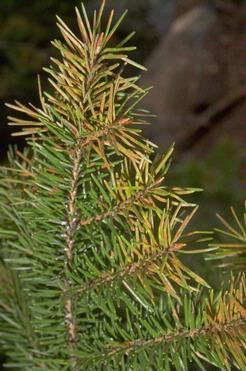
Swiss Needlecast on Douglas-fir
Douglas-fir trees are less common in Grand Blanc landscapes, but if you are experiencing needle loss on your Douglas-fir it is probably due to one of these two tree diseases.
To limit damage from either of these tree diseases fungicide treatments should be applied in the spring as new needles are expanding. Treatments are needed yearly to protect new growth from infection.
Swiss Needlecast photo courtesy of William Jacobi, Colorado State University, Bugwood.org