
Tree Diseases
Dutch Elm Disease - What It Is and How to Protect Your Elms
| Feb 10, 2026
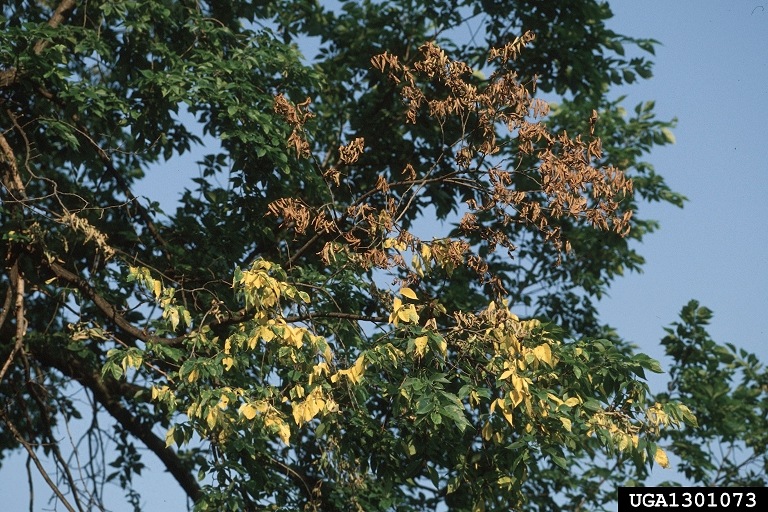
Yellow and wilting leaves from Dutch elm disease. | Joseph Obrien, USDA Forest Service, Bugwood.org
Dutch elm disease is one of the most destructive tree diseases in history. Since its arrival in the United States in the 1930s, it has killed tens of millions of American elms (Ulmus americana) that once formed majestic cathedral-like canopies over streets in towns from coast to coast.
What Causes Dutch Elm Disease?
The most common pathogen that causes Dutch elm disease is Ophiostoma novo-ulmi. This is the more aggressive strain that has largely replaced the original Ophiostoma ulmi.
Dutch elm disease can spread to uninfected trees in two ways:
• Underground through natural root grafts between neighboring elms.
• Above ground by elm bark beetles that carry fungal spores from infected trees to healthy ones.
Classic Symptoms
• Wilting, yellowing, and browning of leaves (“flagging”) starting in late spring or early summer.
• Leaves curl and turn brown while still attached; branches die from the top down.
• Dark brown or black streaks under the bark when you peel it back (the clearest diagnostic sign).
• Rapid death: an infected mature elm can go from healthy to dead in one season (sometimes in just 4–8 weeks).
Prevention & Management – What Actually Works
1. Prune ONLY during the dormant season. Safest window: November 1 – March 31 (the colder the better). Avoid pruning from April 1 through October 31 when beetles are flying.
2. Break root grafts before removing infected trees, same as with oak wilt: trench or vibratory-plow at least 4–5 feet deep in a circle 100+ feet away from any confirmed or suspected infected elm. This is critical in neighborhoods where elms are spaced 30–50 ft apart.
3. Prompt removal of dying or recently dead elms. Dead elms are beetle breeding factories. Remove and destroy (chip, burn, or bury) within weeks of death, especially April–September. Debark logs if you must store them.
4. Preventive fungicide injections (the single most effective tool for high-value trees) Active ingredients that work (all injected by licensed arborists):
• Propiconazole (short-term, cheaper)
• Thiobendazole (Arborfos, etc.)
• Tebuconazole/propiconazole blends. Best current option: Arbotect 20-S (active ingredient thiabendazole) – provides 3+ years of protection with one treatment on most trees.
5. Plant resistant cultivars. Proven DED-resistant American elms now available:
• ‘Valley Forge’
• ‘Princeton’
• ‘Jefferson’
• ‘New Harmony’ Hybrids: ‘Accolade’, ‘Cathedral’, ‘Frontier’, and Asian species (Sapporo Autumn Gold, etc.) also show good to excellent resistance.
Bottom Line
If you have a large, healthy American elm on your property, it is absolutely worth protecting with a 3-year Arbotect injection program plus proper pruning during the dormant season. Many cities that have adopted systematic injection programs (Ann Arbor, Milwaukee, Syracuse, Minneapolis, etc.) still have hundreds or thousands of huge, beautiful elms lining their streets—proof that DED can be managed.
Don’t wait for the first wilted branch. Contact an ISA Certified Arborist at Owen Tree and Lawn Care at 800-724-6680 who is experienced with Dutch Elm Disease for a risk assessment and long-term protection plan.