
Tree Diseases
Girdling Roots on Landscape Trees in Macomb County
| Jan 25, 2026

Girdling root on maple tree. | Owen Tree Service
Girdling roots are one of the most common - and most overlooked - causes of tree decline in many Macomb County landscapes. Homeowners often assume their tree is suffering from insects, drought, or disease, when in reality the problem is buried underground. Girdling roots slowly choke a tree at its base, restricting the flow of water, nutrients within the vascular system of the tree. Left untreated, this condition leads to thinning canopies, bark cracking, dieback, structural instability, and eventually tree death.
The challenge is that girdling roots often remain hidden for years. Trees can look healthy on the surface while the real problem quietly develops beneath the soil. As an ISA Certified Arborist with Owen Tree Service, I see this issue frequently, especially in urban and suburban areas where planting mistakes or compacted soils set the stage for these problems long before they become visible in the tree canopy.
The good news? With the right tools and expertise Air Spading your tree may be able to rescue, stabilize, and put your tree back on track to long-term health.
What Are Girdling Roots?
Girdling roots are roots that grow around the trunk instead of outward and away from it. Instead of anchoring the tree and feeding it properly, they wrap around the base and begin to compress the trunk over time. This compression restricts:
• The upward movement of water
• The downward movement of carbohydrates
• The flow of nutrients
• Overall trunk expansion
Trees rely on free, unobstructed movement inside their vascular system. When a root presses against the trunk, it squeezes this system like a tight belt. Over many years, this pressure weakens the tree’s structural integrity and gradually reduces its ability to support healthy growth.
Why Girdling Roots Are So Common in Macomb County
Macomb County’s heavy, compacted soils make it hard for roots to grow naturally. When roots hit obstacles such as hard clay, landscape fabric, or leftover nursery materials, they may begin to circle the trunk instead of spreading outward.
Common causes of girdling roots include:
1. Improper Planting Depth
The number one cause. Trees planted too deeply or buried under excess mulch develop roots that grow upward searching for oxygen. These roots often become girdling roots, wrapping around the trunk just below the soil surface.
2. Nursery Containers
When trees sit too long in plastic pots, the roots begin circling when they reach the edge of the container. If those circling roots are not corrected before planting, they continue growing in that pattern underground.
3. Wire Baskets, Burlap, and Straps Left Behind
Many trees are installed with:
• Wire cages
• Burlap wraps
• Twine
• Straps around the root ball
If these materials are not fully removed, roots grow around them. Over time, these obstructions may choke the tree or force roots to grow in unnatural directions, leading to binding, restriction, and decline.
4. Soil Compaction
Construction, foot traffic, and lawn equipment compact the soil around trees. Poor soil structure limits natural root expansion, which sometimes encourages roots to circle the trunk instead of expanding outward.
5. Mulch Volcanoes
Excess mulch piled against the trunk causes roots to grow into the mulch layer - which often becomes a perfect breeding ground for girdling roots.
Symptoms of Girdling Roots
Because the problem is underground, many homeowners don't realize anything is wrong until the tree begins showing signs of decline. Common symptoms include:
• Thinning canopy
• Small or undersized leaves
• Early fall color
• Slow growth
• Dieback in the upper canopy
• Cracks or splits where the trunk meets the soil
• A flat or “one-sided” trunk flare
A healthy tree should have a visible, natural root flare - a gentle widening at the base of the trunk. When this flare is missing or buried, it’s a warning sign that girdling roots may be present.
Why Girdling Roots Are Dangerous
Girdling roots don’t just reduce the tree’s health they threaten its structural stability. As they tighten around the trunk:
• The tree becomes weaker
• Trunk tissues die
• The tree loses anchoring strength
• Trunk stability decreases
• Risk of storm failure rises
Many tree failures in residential neighborhoods can be traced back to girdling-root stress that was never known or addressed.
How Air Spading Corrects the Problem
Air Spading is the most effective and safest method for diagnosing and treating girdling roots. This tool uses highly compressed air to remove soil without damaging roots, the root crown, or the trunk.
At Owen Tree Service, we use Air Spading to expose the root flare area which can clearly reveal:
• Girdling roots
• Buried trunk tissue
• Nursery materials (wire cages, burlap, straps)
• Excess soil from deep planting
• Mulch buildup.
Unlike mechanical digging, Air Spading avoids cutting, ripping or otherwise damaging healthy roots. It lets us see exactly what is happening underground so we can make targeted, corrective decisions.
What Happens During an Air Spade Root Collar Excavation?
1. Exposing the Root Flare
We remove excess soil and mulch until the natural flare is visible. This is crucial for tree health and diagnostic clarity.
2. Identifying Girdling Roots
Once exposed, our arborists look for roots that are:
• Crossing the trunk
• Circling the base
• Embedded into the bark
• Growing into wire cages, straps, or burlap
3. Removing Problematic Roots
We selectively prune girdling roots using tools that will cause the least amount of damage to the roots that will remain. The goal is to relieve strangling pressure without sacrificing essential structural roots.
4. Extracting Nursery Material's We Commonly Find
• Wire baskets
• Burlap wraps
• Nylon straps
• Plastic twine
These materials can often remain intact underground for decades.
5. Correcting Soil Grades
After girdling root removal, whenever possible we regrade the soil so it is at, or below, the trunk flare to prevent future issues.
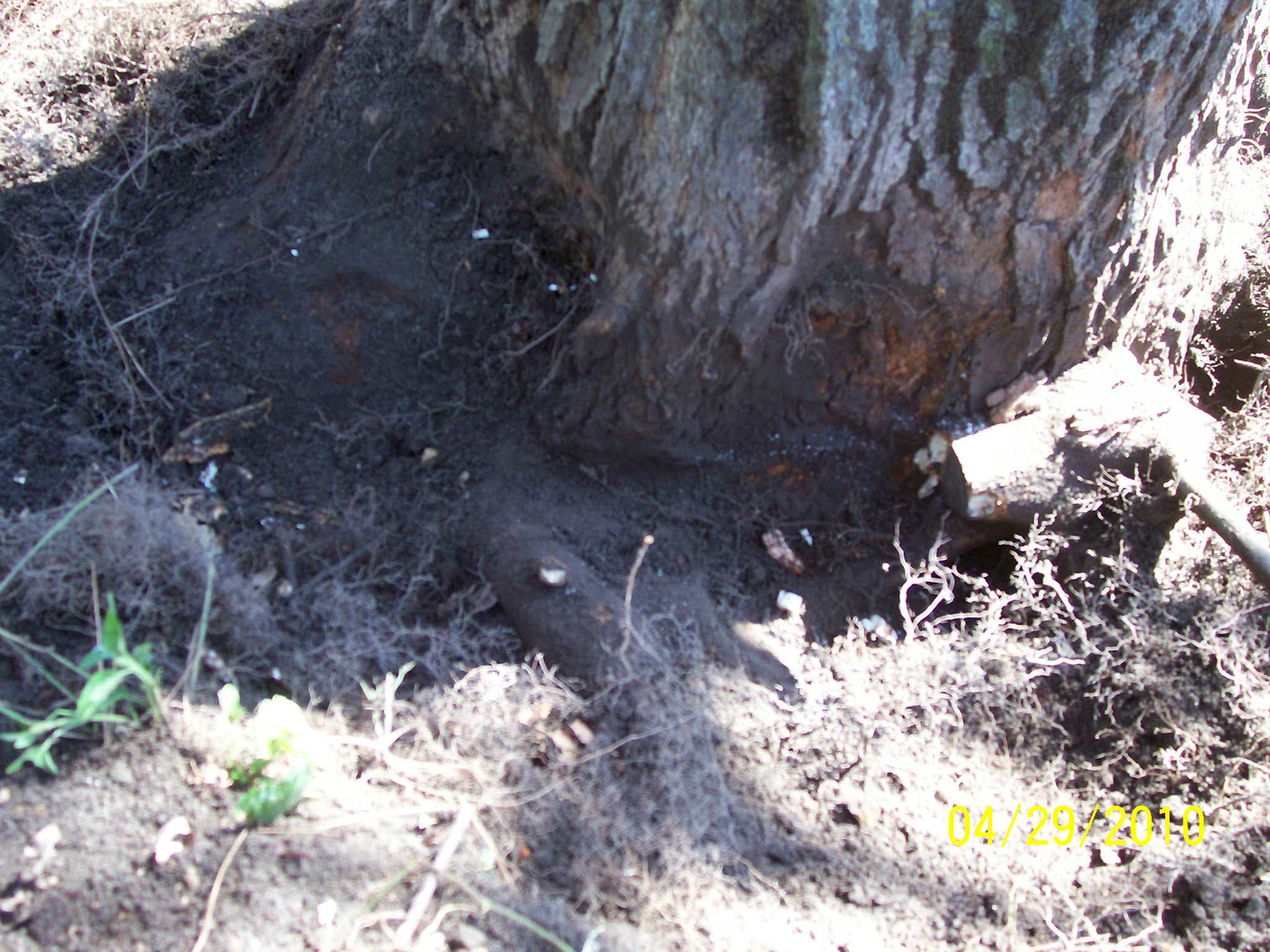 Area where girdling root was removed from maple tree.
The Benefits of Air Spading
Air Spading provides immediate and long-term advantages including:
• Restores proper airflow to the root crown
• Eliminates choking roots and obstructions
• Improves trunk expansion and nutrient flow
• Reduces basal decay and moisture retention
• Enhances structural stability
• Encourages outward root growth
• Boosts overall canopy vigor
Many trees show noticeable improvement within the next growing season - denser foliage, improved color, and stronger structural integrity.
Preventing Girdling Roots in Newly Planted Trees
Although Air Spading can correct existing issues, prevention begins during installation:
• Remove the top part of wire baskets and burlap near ground level
• Cut off twine, strapping, and ropes
• Loosen and, if possible, straighten small circling roots on container-grown trees
• Plant at the correct depth
• Avoid mulch against the tree trunk
Homeowners are often surprised to learn that many planting materials do not break down quickly and may persist underground and cause long-term damage to trees.
Professional Air Spading and Root Correction in Macomb County
Girdling roots are serious, but correctable when addressed early. At Owen Tree Service, our ISA Certified Arborists specialize in root collar excavation, girdling root removal, and correcting the planting mistakes that threaten the long-term health of landscape trees.
We provide:
• Air Spade root investigations
• Root flare excavation
• Girdling root removal
• Soil-grade correction
• Removal of burlap, wire cages and other underground obstacles
If your tree has a buried root flare, thinning canopy, or unexplained decline, it may be suffering from girdling roots. Contact Owen Tree Service today at 800-724-6680 to schedule a consultation with an ISA Certified Arborist and restore the health of your landscape trees.