
Owen Tree Services - Resources
Pear Trellis Rust
Pear trellis rust was introduced into the western United States in the 1990’s and has now made its way east to Michigan. Sadly, it is firmly established throughout much of the metro Detroit area. This foreign disease causes serious damage to fruiting pear trees in its native Europe, and here it is causing devastating damage to flowering pears in our landscapes.
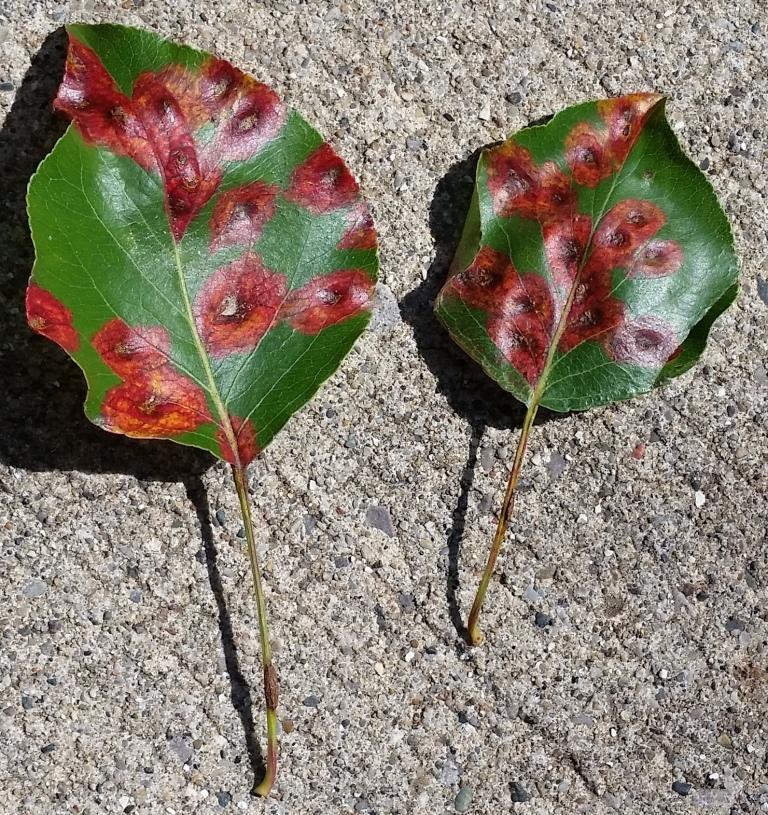
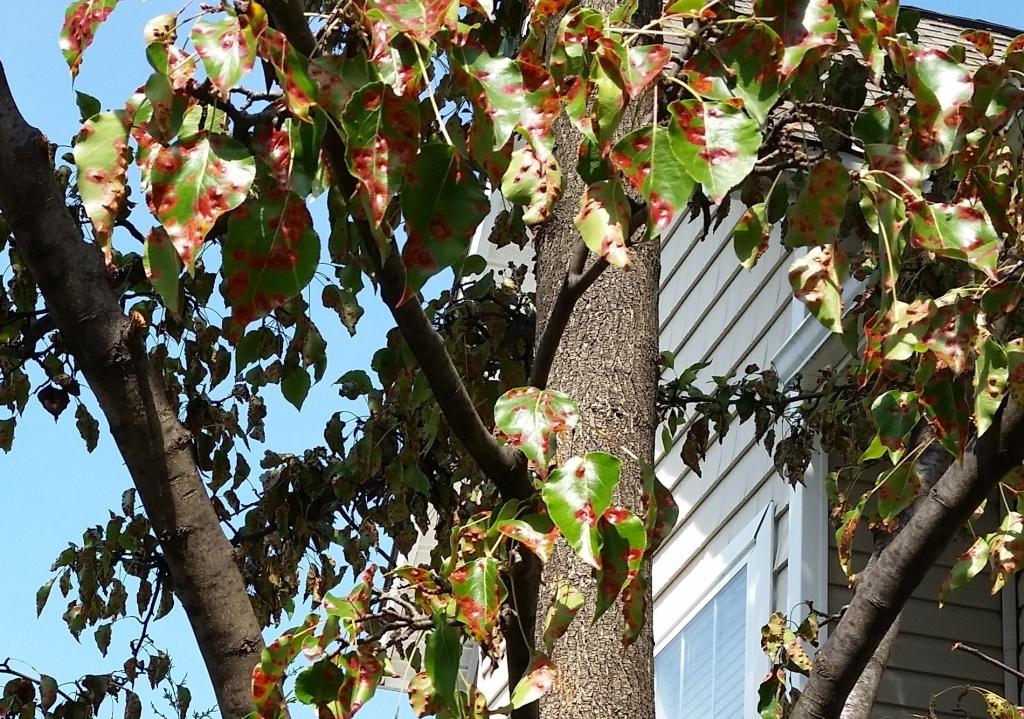
Pear trellis rust is caused by a fungus, Gymnosporangium sabinae, and is similar to our native cedar-apple rust. Both develop on new leaves and fruit. As infection progresses, yellowish-brown spots appear on pear leaves and fruit. By summer’s end these spots have grown and turned to unsightly bright orange-black deformed areas. The fungus then produces fruiting bodies on the undersides of leaves and on the fruit. Not really distinguishable from the leaf spot with our native rust disease, the fruiting bodies of pear trellis rust may best be described as conspicuous orange blobs that split-open to release the seed-like spores.
Also in common with our native rust disease, pear trellis rust requires two alternate hosts to complete its life cycle. Many species of juniper are the alternate host. The infection forms on the stems of junipers, developing into spindle-shaped woody galls. The galls typically do not seriously injure junipers and are only noticeable during a short period of time in the spring. When they are releasing spores, the galls on juniper plants develop orange jelly-like “horns”. These spores are then carried by the wind to flowering pear trees where infection of the pear leaves will occur.
Not only is pear trellis rust an unattractive disease, it injures trees. This is the most important difference between cedar-apple rust and pear trellis rust. Infection from pear trellis rust can be so heavy as to cause pear trees to almost totally defoliate by mid-summer. Defoliation stresses the tree, but pears will replace some of the lost leaves. While this means pear trellis rust may not be fatal, the pear will be unsightly for most of the growing season and have little landscape value. In addition, pear trellis rust will infect and kill twig tissue causing indented areas called cankers. Once twig cankers are formed there is little that can be done to prevent serious infection of the new leaves and fruit.
Treatment options for pear trellis rust are limited. Pruning galls from junipers in early spring before they release spores will reduce new infections. Fungicide sprays are effective, but only on the leaves. Once cankers have developed in the twigs, fungicide sprays are ineffective in preserving good appearance through the summer. Sadly, ornamental pear may be off of our list of useful and beautiful landscape trees.
There is no way to prevent pear trellis rust spores from finding your pear tree. The only option is to prevent the spores from infecting the leaves of your flowering pear. For clients with ornamental pear trees, we recommend two applications of fungicide in the spring to limit leaf infection. At this time, this is the only way to prevent the disease from developing untreatable cankers. Monitoring and removing galls on juniper, or possibly removing the juniper itself, is important around valuable ornamental pear trees.
Counties we Serve
Owen Tree Service is affiliated with the following tree care industry organizations


What Our Customers Are Saying
Tim Nyquist
Responsiveness, Punctuality, Quality, Professionalism, Value
The folks at Owen Tree Service took such good care of my family. We had a massive tree fall on our house and cars, completely upending our lives, and Dave Kidd, Kay Sicheneder, and their whole crew working on it not only did a great job evaluating and removing, but also spent a good deal of time chatting with us, consoling us, offering advice, and generally putting our minds at ease. I sincerely appreciated everything they did for us and would highly recommend them if you’re looking for a good tree service. I can’t thank them enough.
Rick Stomps
Responsiveness, Punctuality, Quality, Value
Owen Tree Service did an outstanding job. The crew trimmed up the treeline and removed several. Did a great job of cleanup too. Extremely professional, informative, helpful & friendly. Thanks so much to the great crew - Ron, Skip, Tim & Doug ... you were incredible. Thanks so much. I'll tell folks about you! (BTW - the guys deserve a few extra $$)
Gayle Rickert
Responsiveness, Punctuality, Quality, Professionalism
Trish did an exceptional job of assessing the tree removal, trimming, diseased/dead trees, and brush removal on our property. She explained the processes clearly and in detail. Trish is an extremely knowledgeable arborist. I highly recommend her to give a comprehensive review & estimate of your landscape needs.
Brandon Rowley
Professionalism
Great people and they always do a nice job. We have used Owen Tree Service for years for various things like tree trimming and lawn care.
Tonia Burns
Responsiveness, Professionalism
Called about having a 17ft tree placed in our yard. Received a call back from Trish you was incredibly gracious with her time and information. Unfortunately, trees that are over 6ft can't be planted by them. However, Trish gave me more than enough info to be confident about having a tree of that sized planted. I'd definitely call and use them for any other future services.
Tyler Smith
I have used Owen for over 10 years. They take care of my Apple tree, shrubs, lawn irrigation and weed/fertilizer. I have always found them to be price competitive, thoughtful and timely. 5 stars from me!