
Owen Tree Services - Resources
Scale Insects
There are many different types of scale insects. The following kinds represent some of the most commonly occurring in Michigan. Scale insects can eventually kill your plants, trees and shrubs. areas.
Oystershell Scale
This insect's waxy covering resembles a tiny oystershell. Most are gray, although there is a brown-colored type. Oystershell scales occur on most deciduous shrubs and trees but cause the most injury to lilacs and cotoneaster. The insects may become so numerous that stems are encrusted. Continued sap feeding by scales can cause branches to become spindly and leaves to turn yellow, eventually killing the plants. Eggs pass the winter under the protective covering of the dead female scale, hatching from late May to mid June. Young scale insects are called "crawlers" and have legs that allow them to move to the new growth. Here they begin feeding by inserting a thread-like feeding tube through the bark. They lose their legs when they shed their first skin, a process called "molting". Young scales then secrete a protective covering.
Oystershell scale Photo: USDA Forest Service Region 2 Rocky Mt Region Archive Bugwood.org
The most effective control strategy is to spray two to three times at about weekly intervals with insecticides, beginning at egg hatch, when crawlers first appear.
Pine Needle Scale
Mature scales are small, slender, and chalky white. The female is nearly twice the length of the males. Heavy infestations on pine and spruce trees cause needles to become yellow, and can kill individual branches. The insect winters in the egg stage under the female scale covering. Eggs hatch about when the new growth appears in the spring. Newly hatched crawlers move to green needles, begin feeding, and produce the typical white covering.
There may be two generations in Michigan, the first hatching in early to mid June, and the second in late July or early August. Use insecticides during the hatching period when crawlers are observed for maximum effectiveness.
Euonymus Scale
Male scales are small, slender, and chalky-white. Females are pear shaped, brown, and about twice the size of males. Euonymous scale is found on all varieties of Euonymous, and will infest a few other types of shrubs. The insect attacks both stems and leaves. Stems often become so heavily encrusted with scales that they appear white. Shrubs can be killed if scale is not controlled.
Mature female scales overwinter on the host plants. Eggs laid under the scales in early spring hatch in late May and early June. During the summer, ail stages can be found at any time, therefore it is possible to have 2 or 3 overlapping generations each year.
Detecting Crawlers
Control will be most effective if insecticide sprays are applied when the crawler (newly hatched) stage is present. Scale crawlers are minute, yellow, oval shaped insects. They are barely visible to the unaided eye, so regular examination should be made with a magnifying glass. Crawlers are mobile only during the first stage of development. This stage has a duration of 7 to 10 days.
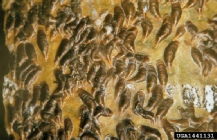
Oystershell scale Photo: USDA Forest Service Region 2 Rocky Mt Region Archive Bugwood.org
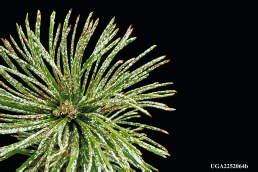
Pine Needle Scale Photo: Scott Tunnock USDA Forest Service Bugwood.org
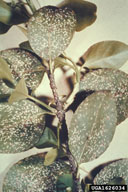
Photo: John A. Weidhass, Virginia Polytechnic Institute and State University, Bugwood.org
Counties we Serve
Owen Tree Service is affiliated with the following tree care industry organizations


What Our Customers Are Saying
Gayle Rickert
Responsiveness, Punctuality, Quality, Professionalism
Trish did an exceptional job of assessing the tree removal, trimming, diseased/dead trees, and brush removal on our property. She explained the processes clearly and in detail. Trish is an extremely knowledgeable arborist. I highly recommend her to give a comprehensive review & estimate of your landscape needs.
Linda Janiszewski
Punctuality, Quality, Professionalism, Value
We are very happy with the work they did. We had a large birch tree trimmed that had power lines on each side. There were 4 workers and they worked well together as a team to get the job done. They cleaned up the yard around the tree and did a professional job. They also asked us if we liked it before they left. We would highly recommend Owen Tree Service!
Tonia Burns
Responsiveness, Professionalism
Called about having a 17ft tree placed in our yard. Received a call back from Trish you was incredibly gracious with her time and information. Unfortunately, trees that are over 6ft can't be planted by them. However, Trish gave me more than enough info to be confident about having a tree of that sized planted. I'd definitely call and use them for any other future services.
New Item
Tyler Smith
I have used Owen for over 10 years. They take care of my Apple tree, shrubs, lawn irrigation and weed/fertilizer. I have always found them to be price competitive, thoughtful and timely. 5 stars from me!
Dean Hartman - Berrien County Drain Commission
Owen Tree Service provided a great value and service to our community. They helped us complete a difficult task of approximately 50 miles of needed treatment almost seamlessly. They were very easy to work with, followed and complimented our directive well. The owners along the areas that were serviced, passed on very nice regards for their team. We were very impressed with Owen Tree Service (as well as the community) and look forward to using their services again this coming year and beyond.