
Insect Pests
Spiders and Spider Mites: Not All Webs Are Created Equal
| Oct 03, 2025
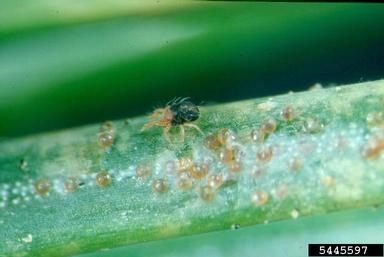
Spider mites on spruce needle. | Ward Strong, BC Ministry of Forests, Bugwood.org
While both spiders and spider mites are arachnids, they have significant differences that can impact your plants and home environment. Understanding these distinctions can help you better manage and appreciate these tiny creatures that inhabit our landscapes.
Web Characteristics
Spiders create geometric, purposeful webs designed to catch prey. Their webs typically:
• Are structured in straight lines
• Connect multiple leaves in clear patterns
• Are strategically placed to trap insects
• Often have a visible spider waiting to catch food
In contrast, spider mites produce chaotic, dense webs that serve a different purpose:
• Webs are fine and sticky
• Completely engulf leaves and stems
• Appear messy and clumped together
• Used for protection and hiding from predators
Physical Characteristics
Spiders:
• Larger in size
• Have two body segments
• Eight legs
• Predatory nature
Spider Mites:
• Microscopic (about 1/50 inch long)
• Oval-shaped body
• Four pairs of legs
• Herbivorous, feeding on plant cell fluids
Ecological Impact
Spiders are generally beneficial, catching and controlling a variety of insects, many which are harmful to plants and people. Spider mites, however, are plant pests. Interestingly, spider mite populations can explode rapidly under hot, dry conditions, completing their entire lifecycle in as little as a week, making them a threat to susceptible landscape plants.
If you notice webbing on your landscape plants, contact Owen Tree & Lawn Care to have an ISA Certified Arborist inspect your landscape. If the webbing is due to spider mites, we can tailor a mite control program specific to the type of mite and plant species being attacked