
Plant Health Care
The Finer Points Of Pear Trellis Rust
| Mar 28, 2025
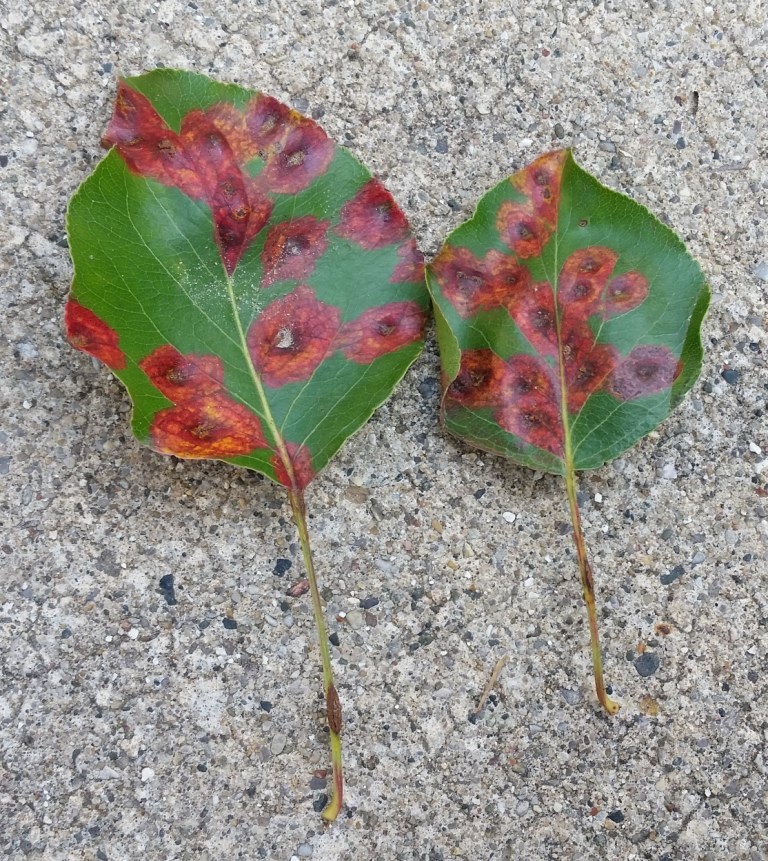
Pear Trellis Rust leaves
One thing about many of us plant health care providers is that we like a challenge. Not only do we find new plant varieties and species introduced into landscapes each year, but all too often new insect pests and diseases are showing up, too. A newer tree disease in our area, pear trellis rust, is one of those new (and challenging) diseases that we have been battling lately.
Pear trellis rust, behaves a bit differently than our native cedar-apple and cedar-hawthorn rusts. All of these rust diseases require two types of hosts: the flowering tree and a juniper plant. Spores produced on trellis rust-infected pear leaves can only infect juniper plants. The spores from the juniper plants, in turn, infect the flowering tree in the spring. Our native rusts form twig lesions only on juniper. However, pear trellis rust causes twig cankers which lead to twig dieback on flowering pear trees. This, in combination with the ability to severely deform leaves can make trellis rust so damaging that pear trees become an eyesore in the landscape.
Twig lesions cannot be treated once formed, and are difficult to prevent. These small cankers will cause the tip of a twig to dieback. When enough lesions are on the twigs of a branch, the entire branch will die.
What gardener hasn’t been advised to pick up and destroyed the spotted, blackened leaves that fall in summer from diseased crabapples and garden plants? This is a way to reduce the number of infectious spores near your valued plants. But this practice, to help control pear trellis rust, is useless. Fallen leaves are well past their spore-releasing ability and cannot infect a juniper plant.
Pear trellis rust spores travel for miles on the wind. In our landscapes, where we like to plant what we know and what is growing so nicely in our neighbor’s yard, there is an excellent chance that pear trellis rust spores will land on a susceptible host. Check out the plantings in your neighborhood. How often do you see ornamental (or Bradford as many people know them by) pear trees? What percentage of flowering pears have some type of juniper planted as ground cover directly under them, or in close proximity? Trellis rust is here to stay and on the move throughout southeast Michigan.
What are we to do to protect the huge population of the beautiful white-flowering pear? At this time, a couple fungicide treatments in the spring have been helping to prevent, or at least reduce, the level of pear trellis rust infection on flowering pear trees. The first application is applied at bud break and the second fungicide is done after the trees have flowered.
Recommendations from Michigan State University are to separate flowering pears from the alternate host by removing juniper plants within 50-100 yards of a flowering pear tree. Additionally, they suggest yearly fungicide treatments for both pear and juniper, and most importantly, planting species resistant to pear trellis rust.
Our approach at Owen Tree Service at this time is:
* Help clients to understand the treatments and their costs, and that treatments will be necessary on an annual basis.
* Examine the site for the alternate host, and determine how important the junipers are to the landscape and the possibility of removing them for a meaningful distance from flowering pear trees.
* Assess pear trees as candidates for routine treatment. Are they otherwise healthy and vigorous? Have they completely overgrown their planting site? Are they surrounded by juniper plants that will not be removed? Has the tree grown with poor form and is likely to break apart in the near future?
* Apply early spring fungicide treatments to protect pear foliage and twigs from infection. Where warranted, apply fungicides in fall to reduce spores formed on juniper.
Pear trellis rust is a challenge indeed. It is our hope, and our business at Owen Tree Service, to help you prepare, protect and recover from tree diseases and pests. Call us with your questions and concerns.