
Tree Diseases
Trellis Rust on Ornamental Pear Trees in Macomb
| Mar 04, 2026
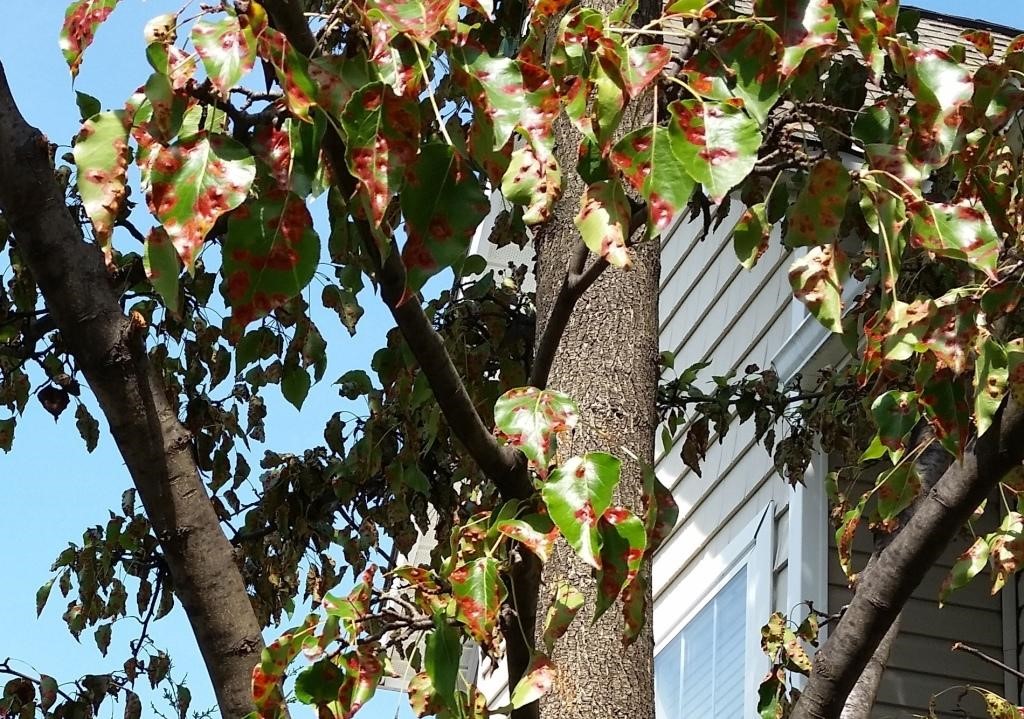
Pear trellis rust on flowering pear. | Tom Morgan
Ornamental pear trees have long been a favorite in Macomb, Michigan neighborhoods for their showy white spring blooms, clean form, and red fall color. Unfortunately, these trees are highly vulnerable to a fungal disease known as Trellis Rust—a condition that disfigures leaves, weakens tree health, and can spread rapidly in landscapes where the right host plants coexist.
As ISA Certified Arborists, Owen Tree Service often responds to concerns about strange orange spots, distorted leaves, or unusual growths appearing on ornamental pears. These symptoms, especially when seen from late spring through summer, frequently point to Trellis Rust. Understanding the disease and knowing how to manage it can help protect the ornamental pears that add beauty and value to your landscape.
What Is Trellis Rust?
Trellis Rust (also called European Pear Rust) is a fungal disease caused by Gymnosporangium sabinae. This fungus has a two-host life cycle, meaning it cannot survive or reproduce on a single type of plant. To complete its cycle, it must move back and forth between:
• Ornamental pear trees (the “secondary” host), and
• Junipers, especially certain ornamental juniper varieties (the “primary” host).
This host-switching requirement is what makes Trellis Rust particularly tricky. Spores travel by wind between junipers and pears, often infecting trees located hundreds of feet apart. Once established, the disease recurs annually unless both hosts are managed.
Why You Should Avoid Planting Junipers Near Ornamental Pear Trees
One of the most important prevention steps often overlooked is not planting junipers near ornamental pear trees. Here’s why:
• Junipers are the overwintering host. The fungus spends the winter inside juniper stems, forming swollen, woody galls or lesions.
• In spring, these galls produce gelatinous, orange, spore-filled structures during wet weather releasing spores that infect ornamental pear trees.
• Later in the summer, spores from infected pear leaves blow back to junipers, restarting the cycle.
Because the fungus requires both hosts, planting junipers near ornamental pears dramatically increases infection risk. Macomb landscapes commonly feature junipers for foundation plantings, screening, and low-maintenance shrub beds which unintentionally drives the disease cycle and spreads Trellis Rust throughout entire neighborhoods.
If you already have junipers on your property, you don’t necessarily need to remove them entirely, but strategic pruning, monitoring, or replacing highly susceptible varieties can reduce disease pressure significantly.
Symptoms of Trellis Rust on Ornamental Pear Trees in Macomb
Trellis Rust is noticeable and often alarming to homeowners once symptoms appear. Common signs include:
1. Bright Orange or Rust-Colored Spots
Small, round, vivid orange spots appear on the upper leaf surfaces in late spring or early summer. These spots continue enlarging as the season progresses.
2. Black Dots Within the Spots
Tiny black dots often form inside the orange lesions—these are fungal reproductive structures developing within the leaf tissue.
3. Tube-Like Projections on Leaf Undersides
On the underside of leaves, you may see tiny, horn-like projections that look like small tubes or bristles. These structures release spores later in the season that infect nearby junipers.
4. Leaf Distortion and Premature Drop
Severe infections cause leaves to twist, curl, or yellow and fall early reducing the tree’s ability to store energy.
5. Occasional Fruit or Twig Infections
While less common, ornamental pear fruit or young shoots may show swelling or deformation like pear scab or fire blight injury.
Because ornamental pear tree's leaf out early in Macomb’s spring climate, they are often exposed during the exact period when spores from juniper plants are most active, making them even more vulnerable.
How Trellis Rust Impacts Ornamental Pear Trees
While Trellis Rust is rarely fatal on its own, repeated annual infections can cause:
• Reduced photosynthesis due to leaf damage
• Chronic stress, making trees more vulnerable to other diseases or insect pests
• Premature defoliation, weakening the tree over time
• Reduced aesthetic value, impacting curb appeal
Stress-sensitive ornamental pears—especially older or declining ones—may develop secondary issues like fire blight or limb dieback if Trellis Rust persists for several consecutive seasons.
Preventing Trellis Rust on Ornamental Pear Trees in Macomb
Preventing Trellis Rust is far easier than treating severe infections. Homeowners can take several practical steps to reduce disease pressure:
1. Avoid Planting Junipers Near Pear Trees
As discussed, removing or relocating susceptible junipers (or avoiding them entirely) breaks the fungal life cycle. If junipers are present:
• Monitor for swollen, woody galls or orange gelatinous masses in spring.
• Consider replacing heavily infected juniper varieties with non-host shrubs.
2. Improve Air Circulation Around Pear Trees
Good airflow reduces humidity on leaves and slows fungal development.
• Prune to open the canopy.
• Avoid crowding trees with dense plantings.
• Maintain proper spacing between pears and nearby shrubs or structures.
3. Maintain Tree Health Through Proper Care
A vigorous tree is far less susceptible to severe infection.
• Water during extended droughts.
• Mulch to retain soil moisture and regulate temperature (but keep mulch away from the trunk).
• Avoid excessive nitrogen fertilization, which promotes tender growth more prone to infection.
4. Sanitation and Leaf Removal
While leaf removal alone will not eliminate Trellis Rust, it helps reduce local spore load:
• Rake and dispose of infected leaves at the end of the season.
• Do not compost heavily infected material.Treatment Options for Trellis Rust in Macomb
Prevention with fungicide applications is the best method to prevent infection—especially for valuable or highly visible ornamental pears.
1. Fungicide Applications
• Professional-grade fungicides can protect leaves from infection when applied at the correct time.
• Applications must occur just before and during the period of spore release, typically early to mid-spring depending on prevailing weather conditions.
• Treatments must be timed precisely, which is why professional consultation is recommended.
• These products protect new leaves but do not cure existing infections.
Fungicides are most effective when paired with juniper host management nearby.
2. Juniper Removal
Removing juniper plants growing near ornamental pears will reduce the number of spores released each spring.
3. Long-Term Management Plans
For properties with multiple pears and junipers—or neighborhoods with frequent outbreaks—Owen Tree Service can develop a management program including:
Monitoring
• Timed fungicide schedules
• Juniper host evaluation
• Structural pruning for airflow
• Soil and plant health treatments
When to Call an ISA Certified Arborist
• Your ornamental pear trees show recurring orange spots on their leaves every year.
• You see unusual orange, gelatinous growths on nearby junipers.
• Leaf drop begins early, or canopy thinning becomes noticeable.
• You want preventative spring treatments timed correctly.
• You’re unsure whether junipers on your property are contributing to the problem.
Early detection and proper timing of fungicide treatments will significantly improve results.
Trellis Rust has become increasingly common on ornamental pear trees across Macomb, Michigan, especially in neighborhoods where junipers and pears are planted close together. While the disease can be unsightly and damaging, it is manageable with the right knowledge and professional care.
With expert diagnosis, preventative planning, and properly timed treatments, Owen Tree Service’s ISA Certified Arborists can help keep your ornamental pears healthy and looking their best year after year.