
Plant Health Care
MDARD Completes 2024 Spotted Lanternfly Tracking Efforts Across Michigan
| Feb 26, 2025
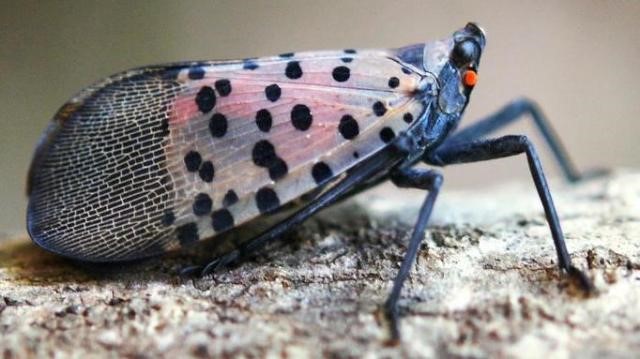
Spotted Lanternfly-Adult
Last month the Michigan Department of Agriculture and Rural Development (MDARD) released its most recent results on its efforts to monitor the presence of the Spotted Lanternfly in Michigan. Unfortunately, new detections of this invasive insect were found in Macomb and Lenawee counties. Two separate populations of Spotted Lanternfly were identified in both Macomb and Lenawee counties.
In Monroe, Oakland, and Wayne counties, where Spotted Lanternfly had already been found, it was discovered that it has expanded its presence.
Spotted Lanternfly, which is native to Asia, was first found in the United States in 2014 in Pennsylvania. Since that time, it has spread to 18 states. After hatching, the insect progresses through several nymphal life stages before becoming a winged adult.
The insect feeds on a variety of plants, but another invasive species, the tree-of-heaven (Ailanthus altissima) is its favorite food source. Several food crops, rose bushes, and grapevines, have also been found to attract Spotted Lanternfly.
Tree species that are commonly attacked by Spotted Lanternfly include:
• Black Walnut
• Fruit trees
• Red Maple
• River Birch
• Willow
The damage to crops is certain to cause anxiety for farmers and gardeners. For Michigan homeowners, the results of Spotted Lanternfly feeding is going to be a cause for concern. The insect sucks juices from the host plant, which results in the production of a waste product called honeydew. This honeydew then becomes a growing medium for a black, sooty mold. Not only does the mold discolor other host plants, but if enough builds up on the leaves it can kill the other plants by inhibiting natural photosynthesis.
Controlling Spotted Lanternfly can be accomplished by disposing of unhatched egg masses, trapping the insects after they hatch, tree spraying, or insecticide soil drenches. Traps will need to be monitored, maintained and cleaned out periodically. Tree spraying for Spotted Lanternfly will require multiple treatments throughout the growing season. Soil drenches should be done after mid-summer.
If you are traveling in areas with known spotted lanternfly populations, be sure to check your vehicle and any items that have been outdoors for the presence of spotted lanternfly insects and egg masses and remove them before leaving.
If you find a spotted lanternfly egg mass, nymph or adult outside of known areas of infestation take one or more photos, make note of the date, time and location of the sighting, and report it online to Eyes in the Field. Photos are necessary to verify a report and to aid in identification.
For additional information on identifying, reporting, and managing spotted lanternfly, visit Michigan.gov/SpottedLanternfly.
To have your property inspected for the presence of Spotted Lanternfly contact Owen Tree Service at 800-724-6680
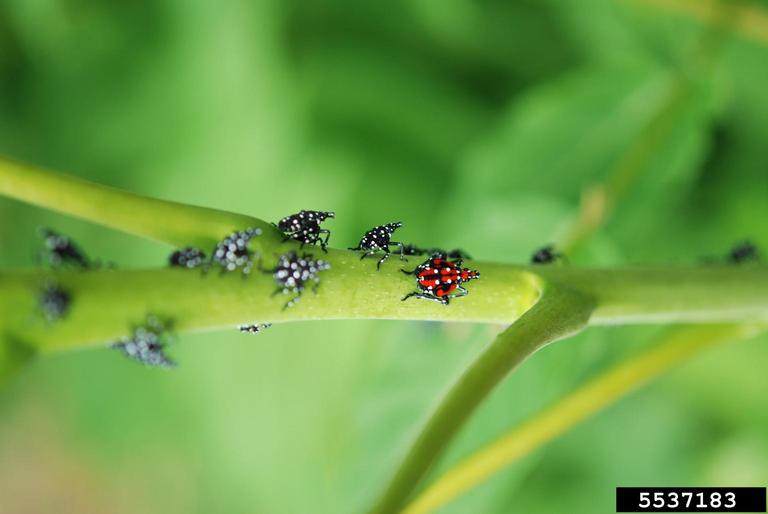
Black & red spotted lanternfly nymphs. | Lawrence Barringer, Pennsylvania Dept. of Ag., Bugwood.org

A current-year egg mass beneath an old egg mass on tree of heaven. | Emelie Swackhamer, Penn State Univ., Bugwood.org