
Plant Health Care
Spider Mites on Bloomfield Hills Landscape Plants
| Sep 25, 2025
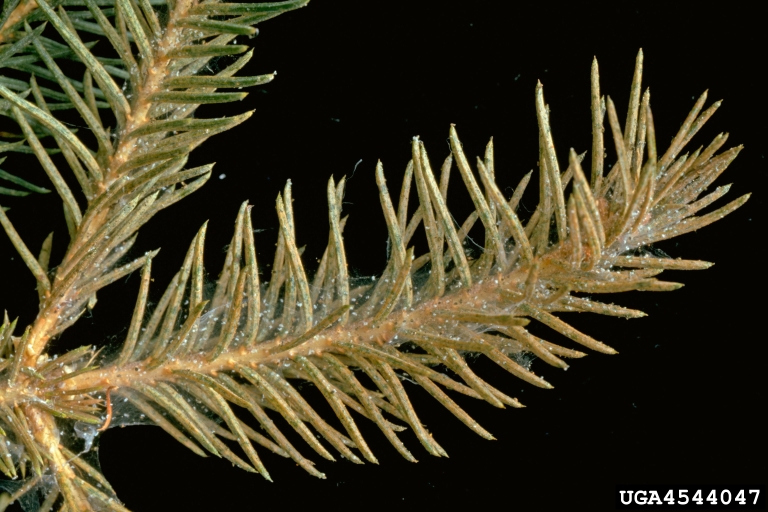
Petr Kapitola, Central Institute for Supervising and Testing in Agriculture, Bugwood.org
Spider mites are a common pest that can wreak havoc on landscape plants in Bloomfield Hills. These tiny arachnids, measuring less than 1/50 inch long, are often confused with other mites or spiders due to their size and webbing. However, spider mites have distinct characteristics that set them apart from their cousins. Unlike other mites, spider mites are known for their ability to produce fine silk webbing, which they use for protection and mobility. This webbing is often the first sign of an infestation, appearing as a delicate, messy network on the undersides of leaves and in leaf crevices.
In contrast, regular spiders create more geometric, organized webs that are typically found stretched between leaves or plant structures. Spider mites thrive in warm, dry conditions, making them a particular problem during the summer months in Bloomfield Hills.
Spider mites have a rapid life cycle, with females laying hundreds of eggs and the development from egg to adult taking as little as 5 to 20 days. This quick reproduction rate allows spider mite populations to explode in a short time, which can result in significant damage to plants.
The most common species in Bloomfield Hills is the two-spotted spider mite (Tetranychus urticae), which attacks a wide range of landscape plants. Two-spotted spider mites attack other plants, including vegetables, fruits, and flowers.
These mites feed by piercing plant cells and sucking out the contents, leading to yellowing, bronzing, or stippling of leaves. To distinguish spider mites from other mites, look for their oval body shape, four pairs of legs, and lack of antennae. Their webbing is typically found in dense, messy clumps on leaves and stems, unlike the more organized webs of spiders.
If you suspect a spider mite infestation in your landscape you should act quickly. Call Owen Tree & Lawn Care to confirm the presence of mites and to develop a mite control plan to prevent widespread damage and protect your plants.